Showing posts with label D. Appendix 1: research for main product. Show all posts
Showing posts with label D. Appendix 1: research for main product. Show all posts
Sunday, 13 April 2014

Friday, 29 November 2013
Audience Research: Questionnaires
 Most of the people survey in this questionnaire (55%) are single which does suggest they are more likely to go to the cinema with friends or family. The people surveyed are therefore more likely to go with their partner as well as friends and family.
As majority of the people surveyed were young enough to be in the key demographic of teenagers and young adults, almost 80% are in education whereas only a very small percentage are unemployed so they are more likely to be able to afford to go to cinema on a regularly.

When asked if they enjoyed horror films, 55% of those surveyed answered that they did although just under 20% answered that it depends on the film so it is likely that horror films would be successful with younger people.

Those surveyed preferred supernatural horror films with over 60% saying so while the thriller and comedy types of horror where also quite popular. Gore was the least favourite sub genre which works in our advantage as many gore films have an 18 certificate that could mean some of the target audience wouldn't be able to see it if we chose to do a gore type trailer.

As over 80% of the respondents visit the cinema occasionally, it suggests they would need to be impressed by a films advertising and storyline before they went to see it.


The people surveyed had a range of favourite elements that were found in a horror film. The two clear favourites at 55% were possession and ghosts/spirits which is good for the group idea of a possession trailer. The least favourite choice is zombies which could suggest they are bored of the genre as many zombie films are very similar.

Many of the people who answered the questionnaire prefer to go to the cinema with their friends however family was also a popular choice. As many young people go to the cinema with friends, this is easy to target a main audience more carefully.
Out of the people surveyed, an equal amount of under 28% enjoyed both happy and mystery endings with a cliffhanger ending being the least favourite. This gives us an indication of how to end the plot of the story and what to hint at in our trailer.
Thursday, 21 November 2013
Horror Trailer Key Conventions
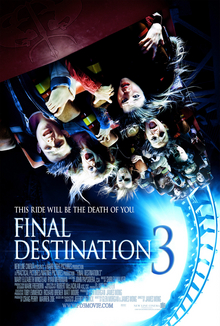 Final
Destination 3
Final
Destination 3
The
non-diegetic sounds which created a tense feeling
Blank
black slides with messages to hint what will happen, giving away little clues
Cliff
hangers before the deaths
Showing
the previous films, encouraging new audiences for people who have not seen the
previous films.
Voice
over of female main character
Not a
lot of gore, however you could tell it was a horror due to the predicted deaths
and also showing the Todorov narrative theory, The equilibrium, the
disequilibrium, but leaving the new equilibrium out to persuade people to go
and see the film.
The Omen
 The evil
child
The evil
child
Losts of
jump shots and fast pace
No music
to begin with then progressively got louder and faster.
The
music and screen shots worked together
The
typical nuclear family
At the
end the main theme of ‘666’ is shown.
Release
date and production company
The Orphan

The pace
was slow but still creepy and tence
Didn’t
give anything away exept from the hint that ‘there’s something wrong with
ester’.
Close
ups of little features.
Ending
of diegratic music of ester singing a typical nursery rhyme
Lots of
crying and screaming.
The
nuclear family
Release
date and production company
Jump
scare at the end.
Sunday, 10 November 2013
Audiences and Institutions: The Woman in Black
- Who do you think the primary and secondary target audience is for The Woman in Black?
The primary target audience of the film is quite clear as it
mainly appeals to the under 25 males and females profiles. As the age certificate is only 12 which is very low for a traditional horror film, this was able to attract a very big primary audience of young teenagers, older teenagers and young adults which is later reflected in the box office figures.
The secondary target audience is a much older audience of adults who may have read the book or seen the play. Being set in the Edwardian era, this appeals much more to an older audience as do some of the other, more established actors such as Ciaren Hinds or Roger Allam who have been in other blockbuster movies. Even though the films plays heavily on Daniel Radcliffe being the lead role, majority of the older audience would also know him through Harry Potter or Radcliffe's theatre performances.
The secondary target audience is a much older audience of adults who may have read the book or seen the play. Being set in the Edwardian era, this appeals much more to an older audience as do some of the other, more established actors such as Ciaren Hinds or Roger Allam who have been in other blockbuster movies. Even though the films plays heavily on Daniel Radcliffe being the lead role, majority of the older audience would also know him through Harry Potter or Radcliffe's theatre performances.
- How was The Woman in Black marketed?
 |
| The Woman in Black main poster |
 |
| 6 sheet advert on bus stop |
 |
| The Woman in Black merchandise |
- Do you think the marketing materials for the film were appropriate? Why?
 |
| Some of the many online articles and reviews of the film |
- What kind of release did the film have?
 |
| An article from The Guardian on the films success |
The film had a very good release with both positive reviews
and a high audience turn out at the box office. In the opening weekend, it made
$20 million and was only behind the Chronicle
that earned a million dollars more which is quite small in box office terms and
was over the $11 to $16.5 million earnings that the film analysts predicted.
Being the biggest grossing film British horror in 20 years, by June 2012 the
title had made $127,730,736 worldwide.
- How much did The Woman in Black cost to make? AND what was the industry impact of The Woman in Black?
The Woman in Black had an estimated budget of $17 million
- Why do you think the film was so successful?
Sunday, 3 November 2013
Friday, 4 October 2013
Narrative Theories in relation to Halloween and The Crazies
 |
| Todorov's theory |
 |
| Myers stalks Laurie at the beginning of the film. |
 |
| Dr Loomis fits the role as the aider in Propp's theory. |
Vladimir Propp had another theory relating to the characters
rather than the actual narrative of the story. Propp was a Russian critic who
studied hundreds of fold tales to compare structures and character types to
which he came up with 8 main roles and 31 narrative functions. These 8
character roles are; the villain, the hero, the donor, the helper, the
princess, the princess’s father, the dispatcher and the false hero to which can
be compared to all kinds of different narratives. In Halloween, the main
character Laurie would be the hero and Myers would be the villain. Dr Samuel
Loomis is the aider as he helps Laurie fight off Myers at the end of the film
although the other characters such as Annie and Lynda in the film are quite
unclear as they don’t fit into one of the eight categories although the
policeman could fit the false hero character loosely and the children could be
seen as the princess role in some ways. The overall film doesn't tend to fit
with the normal theories that would be used in classic Hollywood films as it doesn't have a start or ending that the audience would expect such as the
villain escaping into the darkness at the end of the film.
The binary opposition theory by Claude Levi-Strauss refers to the sets of opposites in a narrative structure. One of the most well-known and used binary oppositions is good and evil as they are opposite values on the scale and is used in all horror films. Halloween fits with this theory as it is clearly demonstrated that Laurie and Dr Loomis is the good and Myers is the evil as well as Laurie fitting with the present, known and normal oppositions where Myers fitting the opposites of past, unknown and strange.
 |
| Laurie is portrayed as the good character whereas Michael is seen as the evil side in relation to Levi-Strauss' theory. |
Bordwell and Thompson have a very clear and precise
definition of narrative of it being “a chain of events in a cause-effect
relationship, occurring in time and space”. This is quite similar to Todorov’s
narrative theory by having one situation to which a series of events will occur
and the pattern of cause and effect will finally create a new situation and the
end. By using the phrase “time and space” means to not only demonstrate or at
least suggest to the audience the time and location but also how quickly the
events take place which can manipulated through flashbacks, replays, slow
motion and jump cuts. In relation to Halloween, the film does fit the theory in
some aspects by the use of manipulation of time and the chain of cause and
effects through the deaths of the friends does lead to a new situation but on
that the audience didn't anticipate.
At the start of the film, there is a
flashback to 1963 where Michael Myers killed his sister and then flashes
forward 15 years on where he has later escaped from the metal institution as it
gives the audience a more clear indication to what actually happened while
keeping it interesting as they obviously couldn't use real time to portray the
story. The whole story from Michael's escape only happens through Halloween
night but it does feel a lot longer when watching the film as so much happens
in the film and the progression from a longer period of time is given a jump
cut to keep the main action in the film and leave out the things that don’t
have reference to story or would bore the audience. For example, you don’t see
the whole night of Laurie babysitting as it would bore the audience and isn't as relevant to the story as the death of one of the friends in the car so it
cuts from one house with the friend to the other house with Laurie babysitting
to keep the audience interested and tense as Laurie becomes more uncomfortable
and uneasy.
 |
| Michael Myers after he had killed his sister when he was a child |
·
Does The Crazies follow the ‘Classic Hollywood
Narrative’?
 |
| The false 'happy ending' for David and Judy |
Although ‘The Crazies’ doesn't conventionally fit the
narrative type, it can be argued that the film does fit Todorvo’s theory of equilibriums.
At the start of the film, everything
seems quite normal which is the clear equilibrium until the events at the baseball
game where it starts to become a lot more dysfunctional. When the infection starts
to come into full effect, this is the disequilibrium and at the end when David
and Judy escape the truck and walk through the fields on the way to Cedar
Rapids can be seen as the new equilibrium. During the credits however shows a
news report of Ogden Marsh as well as a government radar preparing to unleash
the infection on Cedar Rapids, creating a false happy ending.
·
How many of Propp’s character types are evident
in the film?
In The Crazies there are 7 character types that are
portrayed by the characters, the only one left out is the princesses father as all
the characters are adults although it could be said that Davis loosely fits
this type as he is protecting his unborn baby as well as Judy. Many of the
other character types are a lot more obvious such as;
 |
| David and Judy |
- The Villain – The Crazies and the government who invented the virus.
- The Hero – David and Judy (Also Becca when her and Judy are contained)
- The Donor – Russell
- The Helper – Judy
- The Princess – Judy
- The False Hero – Russell
- The Dispatcher - Russell
 |
| Russell who fits the false hero, donor and dispatcher character types |
List 5 examples of binary oppositions in The
Crazies.
Here are many binary oppositions seen within the film, the
most obvious being Infected vs. Healthy as well as Good vs. Evil through the
good civilians and evil crazies as well as the evil government who plotted the
infection. The Normal vs. Strange, Humans vs. Aliens and Known vs. Unknown are
also apparent as David and Judy fit into normal, known humans whereas the
crazies have transformed into strange, unknown aliens although it is unclear
where the government would fit into the binary oppositions. Although they are
villains, they are also human, known and normal just like the heroes except they’re
on the side of the Crazies by turning normal people into them but also shooting
them so they could be considered as a different category of evil.
·
Identify the three durations and give an idea of
how long they are.
The first 10 to 15 minutes of the film are quite normal and
you get to see the characters in their typical, suburban life although there
are some strange occurrences that start to happen such as the shooting at the
baseball game and the man setting his house on fire with his family still in.
Although around 80 minutes of the film were devoted to the Crazies and the
spread of the infection while the characters try to survive, this was about 2
days in real time which was the clear period of the infection. The last 2
minutes where David and Judy were safe after the explosion of Ogden Marsh did
not have a indicated time although with the government planning to repeat the
same process in the neighbouring town – the time when they were safe was
probably around a few days.
·
Give two examples of events that cause events
later in the film but which occur before the film starts.
The invention of the infection and the decision of the government
to infect Odgen Marsh is not explained at any point of the film as it occurred before
the start of the film which only shows the start of the infection spreading
during the beginning. Another aspect of the film that was kept vague was the
plane crash that happened before the film.
Although David and Russell go to investigate the plane which is
underneath the lake, not much more is said after which suggests that this had
something to do with the infection.
·
List two events from the 92 minute film that
happened in another time or space from the ones we see.
 |
| The goverment SUV scene wheer Russell spikes the tyres |
Russell’s actions are often indicated but never properly
explained throughout the film as he makes several escape attempts that aren't
seen on-screen. The first attempt is when the military have separated David, Judy
and Russell. While Judy is sedated and taken to the infected area and David is
evacuated but later escapes back to his office at Ogden Marsh, Russell manages
to escape back to meet David at the office. He explains to David that some of
the people “made a run for it” which he only would have known about if he was
one who managed to escape at that time. The second attempt is revealed later on
in the film where David, Russell and Judy are walking to Cedar Rapids and find
Russell’s old car. While a government SUV is driving past, Russell (who at this
point is becoming increasing angry and showing signs of being infected) throws
a spike strip so they can use the vehicle to which he says “A funny thing
happened on the way to Cedar Rapids. Bastards spiked my tires” that suggests he
previously tried to escape but got caught by the government.
Sunday, 29 September 2013
The History of Horror
The genre of horror has an extensive history of over 100
years and continues to be very popular to this day. From its roots in
literature to the modern gore and video nasties, the genre has managed to
reinvent itself multiple times to keep up to date with the evolution of
technology and the almost limitless boundaries of its audience to which it has
become one of the most classic and well favoured genres of all time.
The starting point of the horror genre was horror literature
and the 3 main 19th century classic tales of ‘Frankenstein’, ‘Dracula’ and
‘Jekyll and Hyde’. Although these three are the most popular of the gothic
movement, the first gothic novel was 'The Castle of Otranto' by Horace Walpole
which was written in 1764. Towards the end of the 18th century, codes and
conventions started to form for the horror genre as more writers started to
form their stories in a similar fashion which reflected in the early 19th
century as strong emotions were reflected in them. During this early time of the
genre, horror was marketed a predominantly female audience and reflected this
by using female protagonists although these often expressed masculine traits
with also seen in the modern horror films. Frankenstein by Mary Shelley, who
was married to Percy Shelley, an early romantic poet published the story
anonymously in London in 1818. 5 years later, Shelley released the second
edition of the story in France where she was credited after the success of the
stage play by Richard Brinsley Peake and was adapted into a film in 1910.
Due
to creation of artificial life by Dr Frankenstein, the tale raised controversy
within the Religion vs. Science argument
as it was seen by many as Dr Frankenstein ‘playing God’, especially in many
Christian dominated countries. One of the scenes in the film adaption caused
outrage with parents as Frankenstein’s monster throws a girl in the lake while
playing to which she drowned. This scene was particularly controversial and
some states in the US censored it from the film. Dracula was written by Bram
Stoker in 1897 and has since been adapted into many film adaptations such as
‘The Wife of Dracula’ and ‘Son of Dracula’. The novel is told through letters
and diary entries by the protagonist and tells the story of a solicitor
travelling to Transylvania to provide legal support for Dracula and soon
realises he has become a prisoner in the castle by Count Dracula. This story
scared its audience as the vampires were used to distance the audience from
reality however, as they could transform into bats made it more realistic and
relatable for the viewers. The last of the three iconic stories, Dr Jekyll and
Mr Hyde was written by Scottish author Robert Louis Stevenson and was published
in 1886 and is often referred to the shorter name ‘Jekyll and Hyde’. The story
told is of Gabriel John Utterson, a London lawyer who investigates his old
friend, Dr Henry Jekyll and the strange occurrences with the evil Edward Hyde.
With the case of Dr Jekyyl, he has a good and an evil personality which has
influenced the phrase of 'Jekyyl and Hyde’ which means someone who has two
vastly different personalities from one situation to the next.
 |
| An iconic still from Nosferatu |
This later developed into the Silent Era and German Expressionism in the 1910's and 1920's which explored both action and comedy although the film makers also explored darker themes with the supernatural and psychology while experimenting with the new technology and photographic trickery. The audience at the time was extremely interested in ghosts and magic lantern shows which could be shown through the development on cameras and various filming equipment to tell interesting and bizarre tales which would thrill their audience that had never been done before. One of the first silent horrors was 'Le Manoir du Diable' in 1896 by Georges Méliès, who was to become one of the leading filmmakers of his generation and combining the use of magic and illusion into his work. This supernatural clip saw the introduction of the horror iconography by including bats, caldrons, ghosts and trolls. German expressionism was an arts movement of film, painting and architecture during the 1920’s which later expanding to Europe and one of its most famous films from this movement was ‘The Cabinet of Dr Caligari’ by Robert Wiene.
After a two decades of silent movies, sound started to become very
popular in the horror genre and had a huge impact on the genre and how it uses
sound to suit the mood of the film. As this was a new concept to the film
makers at the time, many of them struggled to adapt to the new technology to
add sound which could build up the tension or magnify a certain sound for the
audience. During this period, the films had developed into fairy tales and had
very dreamlike effects to add another dimension to the literary classics that
they was basing them on, however this had a significant impact as horror films
became more popular and mainstream to the wider public which reflected in the
figures. To escape the reality of a fore coming war and the Depression, 80
million people visited the cinema on a weekly basis that lead to an increase in
the amount of horror films being made at the time. Films such as James Whale’s
‘Frankenstein’ and Tod Browning’s ‘Dracula’ were extremely popular as they
combined serious elements along with excitement to thrill the audience as well
as some films combining horror with the sci-fi genre such as ‘The Invisible Man’.
Through the 1940’s, Britain along with many other countries
were feeling the effects of World War 2 which was effectively used within the
film industry with animals such as wolves and cats. Hitler and his ideologies
were portrayed through wolves as Adolf Hitler was a translation of ‘noble wolf’
is Old German and many of the Nazi Party HQ’s were named after several wolves.
‘The Wolf Man’ was a very popular film at the time as not only did it include
wolves to signify the Nazi’s, the screenwriters own issues were reflected in
the film through the characters fleeing America. Later on, cats representing
frustrated women who had lost their jobs to the men who and returned from the
war became dominate which an example of this is ‘Cat People’ released in 1942.
 |
| Christopher Lee as Dracula |
Throughout the 60’s and 70’s; ghosts, zombies, Satanism and
families became a hit as these films dealt with contemporary society issues and
psychological fears such as children and childbirth through big budget movies.
One of the most popular films of all time, ‘The Exorcist’ featured both
children and Satanism as the movement wanted to suggested that the enemy is a
lot closer to home than what was portrayed in the past as well as the existence
of the Devil. Ghost stories had also become quite popular as it leads the main
character through the unclear line of sanity and insanity with the paranormal.
 |
| A still of the killer from Halloween |
With the popularity of VHS tapes, videos nasties became
popular in the 1980’s as they could be released straight to tape instead of
being shown in the cinemas due to the low budget of these types of films. It could be said they caused controversy as
they didn’t have any regulations on them and could be watched by anyone in the
home and often did not have a age certificate set by BBFC that lead to panic in
the media of what children and teenagers were watching. A total of 39 films
were banned in the UK and were named ‘Video nasties’ as in 1984, the government
passed the Videos Recording Act that meant they had to regulate the films
released and sold but this soon directed to a more underground film industry.
These controversial films such as ‘Child’s Play 3’ have often been connected
with real life cases, such as the murder of James Bulger.

Subscribe to:
Posts (Atom)